OAA on the Move: Advancing Organic Acidemia Research This Summer
Here at the Organic Acidemia Association, our mission isn’t just about providing support today. It’s about driving the research that will improve lives tomorrow. This summer, we’ve been busy representing the patient and family voice at two major scientific gatherings: the 46th Annual Society for Inherited Metabolic Disorders (SIMD) Meeting in Puerto Rico and the kick-off meeting for the newly established ROAR Consortium in Houston, Texas.
Connecting with the Global Medical Community at SIMD 2026
From May 17th through the 20th, we joined metabolic geneticists, researchers, and biochemical trainees in Rio Grande, Puerto Rico, for SIMD 2026. This conference is a critical forum for sharing the latest clinical practices and bench research on inborn errors of metabolism.
Being on the ground at SIMD allows us to stay at the cutting edge of potential treatments and translate dense, complex scientific data back into actionable updates for our community. Most importantly, it reminds the clinical and research community that the lived experiences of our families are the most critical data points of all.
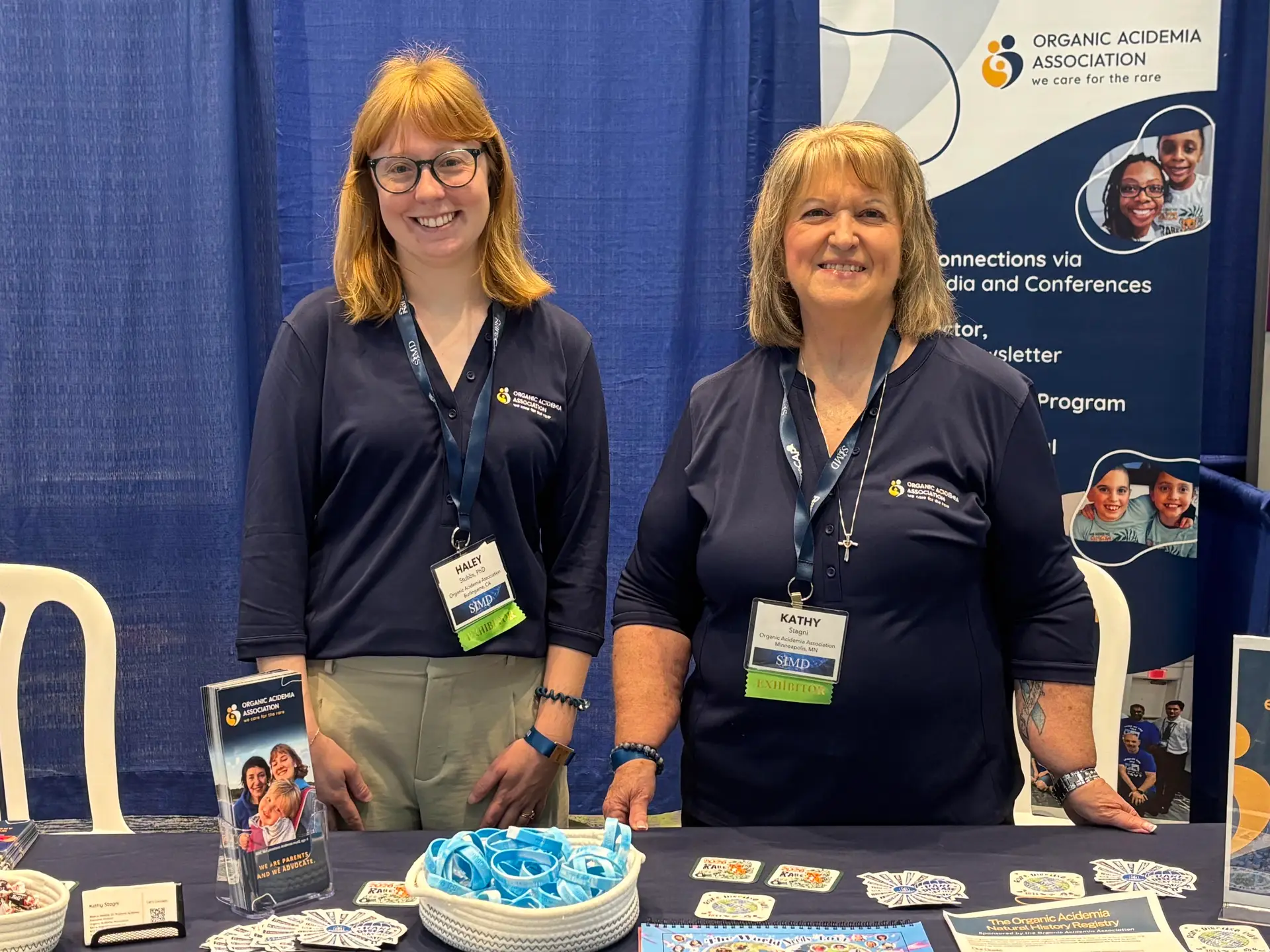
OAA hosted a booth to inform clinicians and pharma partners on our resources. We shared magnets from our rare disease day fundraisers, showed off our 2026 calendar, and gave out rack cards with information on our registry, newsletter, and patient assistance program.
Several people presented posters on new treatments and outcomes for patients with organic acidemias. Irini Manoli, M.D., Ph.D. presented data from the NIH’s natural history study of MMA and Cobalamin disorders.
NIH study graphic: MMUT mutation (32%) in 101 out of 315 MMA & Cobalamin Disorder cases.
Irini Manoli, M.D., Ph.D. presenting data from the NIH MMA and Cobalamin disorders longitudinal study.
Carolina I. Galarreta Aima, M.D. presented a poster on the differences in renal trajectories and biomarkers between propionic acidemia and methylmalonic acidemia. Better understanding of biomarkers in both PA and MMA can help clinicians and their patients with decision making around using renoprotective measures.
Carolina I. Galarreta Aima, M.D. presenting a poster on assessing renal biomarkers for their efficacy in early prediction of chronic kidney disease in PA and MMA
A New Era of Collaboration: The ROAR Consortium Kick-Off
Following SIMD, we headed to Houston, Texas, on May 26-27 for a milestone event: the kick-off meeting of the Rare Organic Acidemias Research (ROAR) Consortium.
Funded as part of the Rare Diseases Clinical Research Network (RDCRN) and coordinated out of Baylor College of Medicine and Texas Children’s Hospital, ROAR is the first multi-site, prospective longitudinal U.S. study devoted entirely to organic acidemias. The OAA is incredibly proud to be an active, founding member of this consortium, partnering alongside the Propionic Acidemia Foundation, leading clinical sites across the country, and the intramural program at the National Human Genome Research Institute (NHGRI).
During the two-day kick-off, we laid the groundwork for how this collaborative network will function. The consortium’s primary goals align perfectly with our ongoing registry initiatives and research priorities:
Deepening Natural History Studies: Improving our understanding of the long-term consequences of organic acidemias as patients grow into adulthood.
Achieving Clinical Trial Readiness: Ensuring that as new, targeted therapies are developed, the clinical infrastructure and patient data are fully prepared to test them safely and efficiently.
Prioritizing Patient Voices: By having the OAA at the leadership table, we ensure that research priorities reflect the real-world, day-to-day concerns of our families.
What This Means for You
Progress in rare disease research requires clinicians, researchers, and patient advocacy groups working in lockstep. Our presence at SIMD and our foundational role in the ROAR Consortium mean that the organic acidemia community is not just waiting for scientific breakthroughs. We are actively helping to design the studies that will make them happen.
We look forward to sharing more specific research updates from both of these initiatives in the coming months as the ROAR projects get fully underway.
We use cookies on our website to give you the most relevant experience by remembering your preferences and repeat visits. By clicking “Accept”, you consent to the use of ALL the cookies.
This website uses cookies to improve your experience while you navigate through the website. Out of these, the cookies that are categorized as necessary are stored on your browser as they are essential for the working of basic functionalities of the website. We also use third-party cookies that help us analyze and understand how you use this website. These cookies will be stored in your browser only with your consent. You also have the option to opt-out of these cookies. But opting out of some of these cookies may affect your browsing experience.
Necessary cookies are absolutely essential for the website to function properly. This category only includes cookies that ensures basic functionalities and security features of the website. These cookies do not store any personal information.
Any cookies that may not be particularly necessary for the website to function and is used specifically to collect user personal data via analytics, ads, other embedded contents are termed as non-necessary cookies. It is mandatory to procure user consent prior to running these cookies on your website.
Select Language
Subscribe to our Blog / Newsletter
Thanks for subscribing to the OAA newsletter/blog list!