
- By oaanews
- July 20, 2026
- 0 Comments
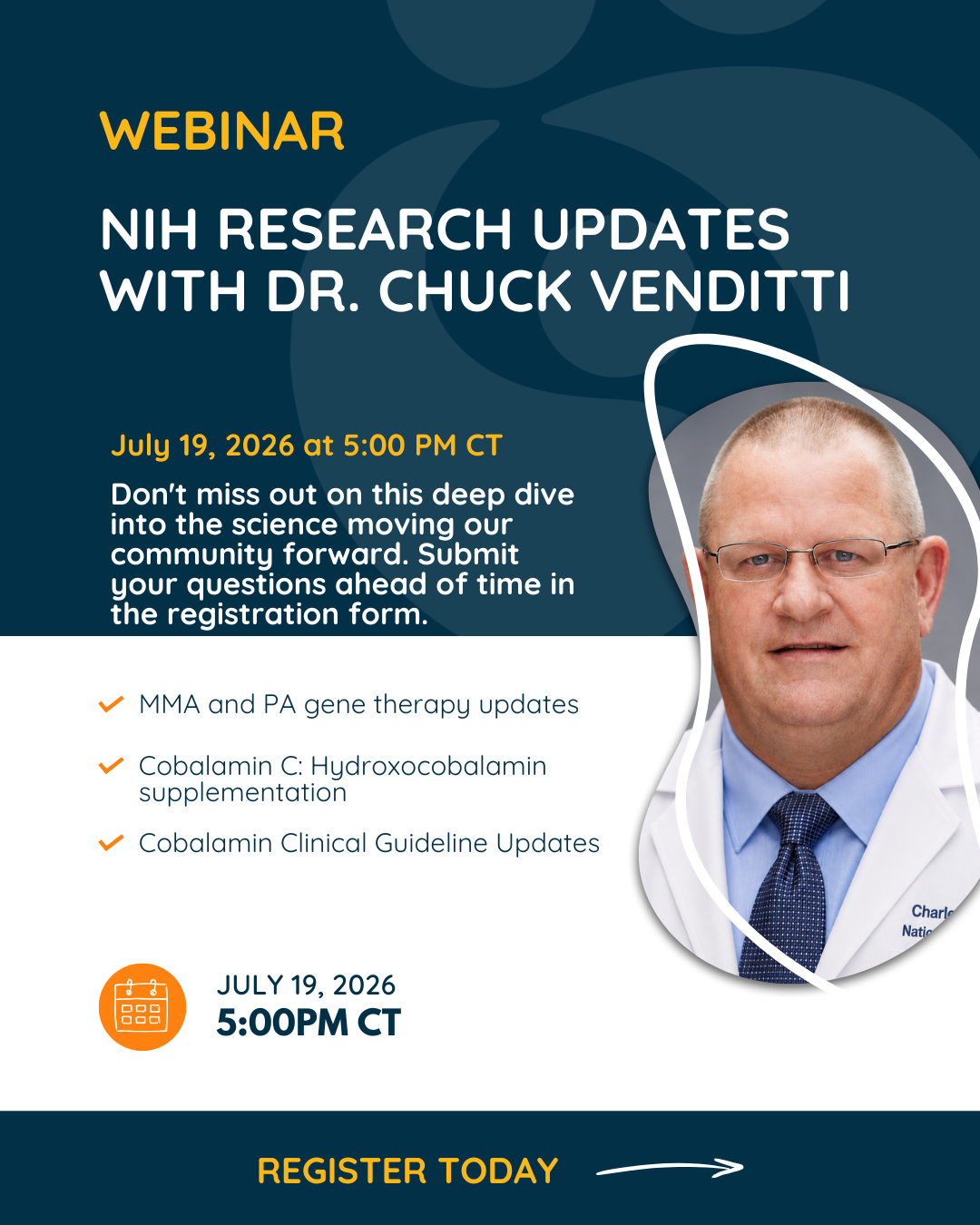
Webinar Recap: NIH Research Updates with Dr. Venditti
With our biennial Family Conference pushed to next summer, OAA hosted a special research webinar to keep our community connected to the latest developments at the National Institutes of Health. We were honored to welcome Dr. Charles (Chuck) Venditti, Senior Investigator and Chief of the Metabolic Medicine Branch at the National Human Genome Research Institute (NHGRI), along with two members of his Organic Acid Research Section team: Dr. Irene Manoli, senior research physician, and Jennifer Sloan, genetic counselor and protocol coordinator. Together, they gave families a broad, patient-focused update on natural history research, new clinical guidelines, and the therapies moving toward the clinic for MMA, propionic acidemia (PA), and cobalamin C (CblC) deficiency.
Attendees joined from all over the world, including families dialing in from Brazil and Spain, alongside our U.S. community.
Dr. Venditti opened by thanking the families who make this research possible, sharing that it was patients and parents who encouraged him to pursue this work early in his career, when he was told these disorders were “not treatable.” Nearly three decades later, that persistence is paying off.
Training the Next Generation
Dr. Venditti also spoke with pride about the role families play in training future physicians and researchers. He shared that every clinic visit and study sample contributes not only to research findings, but to the education of the students, fellows, and trainees who rotate through his lab and clinic. He highlighted a group of trainees who came through the program between 2025 and 2026, noting that each one went on to pursue further training— from MD/PhD scholarships to medical school, graduate school, and work on next-generation RNA therapeutics. He also pointed to two pediatric residents from Children’s National Medical Center who trained with his team and went on to specialize in areas shaped by that experience: one now works as a pediatric geneticist with a research focus on CblC, and the other is pursuing pediatric critical care after working on PA gene therapy. Dr. Venditti called this an important, if often overlooked, benefit of NIH’s research program: building a pipeline of physicians and scientists who understand these rare disorders well.
Why These Disorders Matter and How Common They Really Are
Organic acidemias were first described in the 1960s and, for years, were assumed to be exceedingly rare. Dr. Venditti pointed to newborn screening data from more than 4.5 million babies born in California, which found that when MMA, PA, and CblC deficiency are grouped together, they represent the third most common group of conditions identified through screening — far more frequent than earlier estimates suggested. In some regions of the world, including parts of China, CblC deficiency is more common than PKU.
What NIH’s Natural History Studies Are Teaching Us
The NIH operates two major natural history studies. One is for MMA and related cobalamin disorders, and the other for PA. Together, these studies have 382 participants. These studies don’t test experimental treatments; instead, they carefully track how the conditions progress over time, collecting detailed clinical data along with blood, urine, and stool samples (the team now holds between 8,000 and 10,000 linked specimens). This resource has been essential for identifying and validating biomarkers that help predict how a patient’s disease may progress.
One example Dr. Venditti shared: research led by Dr. Oleg Shchelochkov found that kidney function in PA patients declines gradually with age, often earlier than previously recognized. This finding that is reshaping how clinicians monitor and manage kidney health in these patients over the long term.
New 2026 Treatment Guidelines for Cobalamin C Deficiency
A major highlight of the evening was an update on new international clinical guidelines for CblC deficiency, led by Dr. Manoli and a global panel of experts and patient representatives who reviewed roughly 300 published studies before finalizing their recommendations. Compared to the prior 2017 guidelines, key updates include:
Individualized, often higher-dose hydroxocobalamin regimens. The guidelines move away from a single standard dose, recognizing that many patients, particularly those with early-onset disease, need substantially more than the “0.3–1 mg/kg/day” once considered standard.
Earlier, more aggressive retinal monitoring, including optical coherence tomography (OCT), to catch eye involvement as early as possible.
Broader systemic monitoring, including amino acids, methionine, head circumference, neurocognitive assessment, cardiac screening, liver evaluation, and kidney function as patients age.
Continued support for newborn screening and genetic correlation, since specific gene variants (such as the 271 duplication) are associated with more severe outcomes.
A reminder that CblC patients should never be placed on medical foods.
Dr. Manoli also addressed several audience questions on dosing directly: hydroxocobalamin doses are adjusted by weight (mg/kg/day) rather than losing effectiveness with age, and betaine remains an important part of long-term management, especially as children grow and can no longer feasibly receive the very high daily doses of hydroxocobalamin used in infancy.
Therapies in Development
Dr. Venditti walked the audience through the long path a therapy travels from an idea in the lab to something a physician can eventually prescribe Development starts with early preclinical work and animal studies before a clinical trial is planned. After proof of concept studies, researchers submit an Investigational New Drug (IND) application to the FDA. If approved by the FDA and other regulatory processes, a clinical trial can begin.
The most significant news of the evening: the NIH’s gene therapy program for MUT-type MMA has cleared the FDA’s IND review, a major regulatory milestone announced by the National Center for Advancing Translational Sciences (NCATS) on May 8. Dr. Venditti was careful to note what this does and doesn’t mean. It clears the way for the NIH to move forward internally, but a biosafety review, an internal resource review, and Institutional Review Board (IRB) approval of the clinical protocol still need to be completed before the trial can open. He expressed hope that these remaining steps would be finished by fall, at which point a clinicaltrials.gov listing would go live and recruitment could begin.
This program builds on AAV (adeno-associated virus) gene therapy research the team has been refining for years, using animal models for MUT-type MMA, MMA B-type deficiency, and PCC-related PA, with promising early data in CblC as well, though that program is less advanced. Dr. Venditti also acknowledged Selecta Biosciences, whose donated viral vector helped revive and accelerate the MUT-MMA program.
Questions from Our Community
Dr. Venditti, Dr. Manoli, and Jennifer Sloan fielded a wide range of questions submitted by families, including:
Transplant longevity: With careful monitoring and management of immunosuppression, combined liver-kidney and kidney transplants can function well for decades. Some patients have had functioning grafts for 20 to 30 years.
CblC and diabetes: No established connection in NIH’s patient population, though the team noted an intriguing recent genomic study from Pakistan that used different biomarkers and found some associations that may be worth further exploration.
Choline, DHA, and retinal health: A family asked whether there’s any evidence that choline or DHA supplementation could support the Kennedy pathway and help retinal function in CblC. Dr. Venditti called it “a very good comment” and an intriguing idea, since choline and DHA are involved in lipid synthesis in photoreceptors, but noted he’s not aware of anyone having formally studied this question. He offered a related observation from brain imaging: on magnetic resonance spectroscopy, some CblC patients show a low choline peak. The open question is whether that reflects a broader methyl-donor shortage — since the whole methylation cycle is depressed when cobalamin is low — rather than a photoreceptor-specific issue. As a point against a primary, disease-specific mechanism, he noted that patients with other remethylation disorders (such as MTHFR deficiency), who also have disrupted methylation, do not tend to show the same eye changes seen in CblC. He said this is worth paying more attention to going forward.
Transplant vs. gene therapy: The team emphasized that families should never delay needed medical care, including transplant, while waiting on research therapies that remain uncertain in timing. Decisions are guided by clinical status, genotype, and NIH’s specialized biomarker and breath-test assays that help estimate residual enzyme activity.
International access to high-dose hydroxocobalamin: Dr. Venditti acknowledged this remains a serious, unresolved challenge for families outside the U.S., sharing that he often feels helpless trying to advise families who can’t get the medication shipped to their country. He suggested that a more widely available, FDA-approved formulation could ultimately make it easier for other countries to permit access, since it could be recognized as an approved medicine. He also expressed interest in hearing from the community about strategies individual families have used successfully.
How to Get Involved
Families interested in learning more about the NIH natural history studies or in being considered for the upcoming MUT-MMA gene therapy trial once it opens are encouraged to reach out directly to Dr. Venditti’s team by email at NHGRIVendittiClinical@mail.nih.gov. Participation in the natural history study is free, and for those who travel to NIH, housing at the Children’s Inn and all study-related testing are covered.
Save the Date
Dr. Venditti and his team plan to join us in person at OAA’s Family Conference, June 25–26, 2027, in Minneapolis. We hope you’ll start making plans to attend — and to continue this conversation face-to-face.
Thank you to Dr. Venditti, Dr. Manoli, and Jennifer Sloan for generously sharing their time and expertise with our community, and to every family whose participation in NIH’s research makes this progress possible.
OAA supports organic acidemia research with scientific and clinical research grants. If you would like to contribute to OAA research grants you can make a donation here.