
- By oaanews
- June 29, 2026
- 0 Comments
Webinar Recap – Rare Disease Clinical Trial Design: Start with the Patient and Use the Best Science
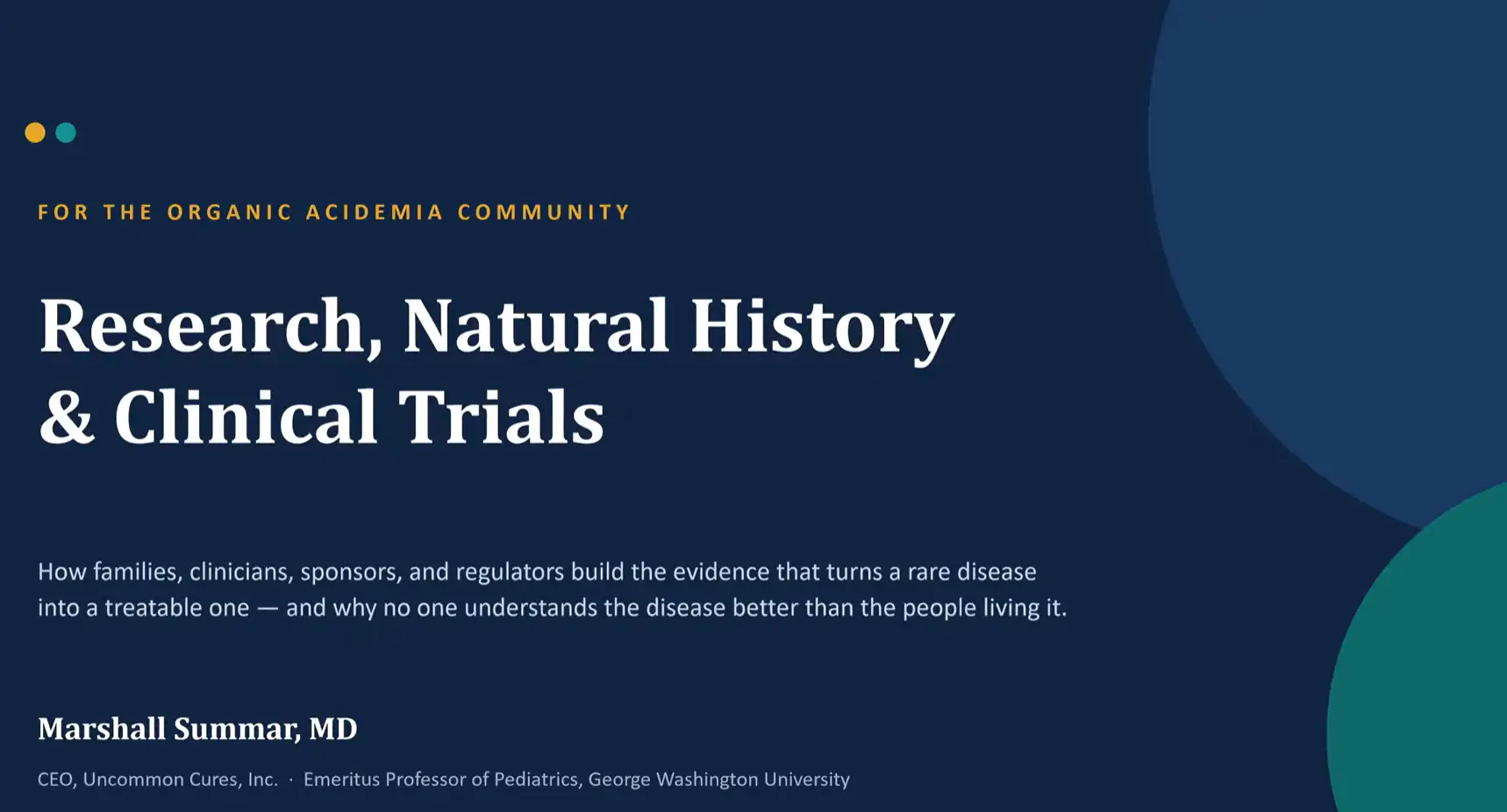
In our latest Organic Acidemia Association (OAA) webinar, “Rare Disease Clinical Trial Design: Start with the Patient and Use The Best Science,” now available on our YouTube channel, we took a deep dive behind the scenes of clinical research.
The session shifted the conversation away from viewing patients purely as “subjects” and focused heavily on equipping our community to be active, informed consumers and partners in drug development.
Meet the Speakers
The webinar featured two leadership figures from Uncommon Cures, an organization dedicated to making rare disease clinical trials more efficient and patient-centered:
Dr. Marshall Summer: A renowned clinical geneticist with nearly 40 years of experience in the rare disease field. He has been involved in more than 100 clinical trials and is the founding director of the Rare Disease Institute at Children’s National Hospital in Washington, D.C., as well as the former board chair of NORD (National Organization for Rare Disorders).
Carrie Gallagher: The Vice President of Operations at Uncommon Cures. Carrie brings over a decade of leadership experience in emergency nursing at Children’s National and more than two years in organ transplant and procurement operations. She specializes in reviewing protocols to ensure they are operationally practical and minimally burdensome for families.
The Big Picture: Rare Disease Economics and Realities
Dr. Summer kicked off the webinar with some surprising metrics. While individual rare conditions affect small numbers, collectively, orphan drugs represent roughly 18% to 20% of global pharmaceutical sales.
Crucially, rare disease trials actually see a higher success rate than common fields (about a 30% success rate compared to just 10% in general medicine). Because researchers typically understand the exact molecular and genetic defects driving an organic acidemia, therapies can be highly targeted.
However, Dr. Summer noted that a 70% failure rate is still far too high. Interestingly, most rare disease programs fail because of operational issues (recruitment and retention) rather than bad science. Over the last 26 years, roughly $23 billion has been lost to stalled or failed rare disease trials—much of which could have been saved with better study design.
Redesigning the Playbook: Moving Away from the “Gold Standard”
For decades, the pharmaceutical industry has viewed the randomized, double-blind, placebo-controlled trial (RCT) as the gold standard. Dr. Summer challenged this approach for the organic acidemia community:
The Math Problem: Classic statistical models rely on large numbers. In rare conditions, trying to compare highly variable patients against one another dilutes the biological data.
The Ethical Dilemma: In a progressive metabolic condition affecting children, placing a patient on a placebo when a targeted therapy is available raises serious ethical concerns.
The Better Solution (“Patient as Their Own Control”): Instead of comparing a child to a stranger, the most powerful statistical design in rare disease measures a patient’s changes against their own unique baseline. This internal consistency means a trial can achieve the same statistical power with 10 to 15 times fewer patients than an RCT.
Real-Life Practicality: Designing for the Family
Carrie Gallagher brought a vital bedside perspective to the conversation, stressing that protocols must look at the total hours a family spends participating, not just individual visit lengths. She highlighted key areas where protocols frequently break down:
1. The “Rainbow” of Blood Draws
Pediatric patients have strict, safe blood-volume limits (typically capped at 5 mL per kilogram over any 30-day period). Despite this, many investigators from adult medicine pack protocols with “nice-to-have” lab draws. In organic acidemias—where patients may already suffer from bone marrow suppression—excessive research blood draws have historically forced patients to require blood transfusions. Gallagher advocates for strict micro-sampling, combined tubes, and eliminating non-essential data points.
2. Family Dynamics & Single Incomes
Many families do not live near an academic center, operate on a single income, or have other children to care for. If a trial requires frequent travel or a multi-month stay without a dedicated, familiar home-health care team, families will drop out.
The Ultimate Value of Community-Owned Natural History Studies
Both speakers agreed: A robust natural history study is the single most valuable asset a disease community can build.
Without data tracking how a disease progresses naturally over time, drug companies cannot select accurate endpoints (the markers that prove a drug is working). Strikingly, a strong natural history study can even serve as a “surrogate control arm” to help get a drug approved by regulators like the FDA, eliminating the need for a placebo group entirely.
Dr. Summer emphasized that the patient community must own this data. When data is locked inside a single university server or a corporate file, it frequently gets lost when an investigator retires or a company shifts priorities. When the registry is owned by a patient advocacy organization (like the OAA), the data outlasts individual entities, protects patient privacy, and can be licensed safely to multiple sponsors over time.
Navigating Complex Decisions: Early Transplants vs. Clinical Trials
During the interactive Q&A session, a critical topic was raised regarding young organic acidemia patients who undergo liver and/or kidney transplants early in life.
Because transplants modify the underlying metabolic environment, these children often become ineligible for emerging gene therapies or mRNA clinical trials. When asked how new parents should navigate this high-stakes choice, Dr. Summer and Carrie shared key perspectives:
Trading One Disease for Another: A transplant is a life-extended therapy, but it is not a complete cure. It may shield specific organs, but it doesn’t always prevent other systemic issues (like cardiac or renal complications in Propionic Acidemia or Methylmalonic Acidemia), and it introduces new lifelong challenges like immunosuppression.
Say No to Placebos in Urgency: Dr. Summer stated candidly that if a family is forced to choose between an immediate organ transplant and entering a clinical trial that includes a placebo arm, choosing the transplant is often the safer, more logical medical decision.
Transplant Patients Belong in Registries: It is a misconception that once a child receives a transplant, their data is no longer relevant to research. Because the long-term horizons of transplanted organic acidemia patients are still being mapped, their participation in natural history studies is more critical than ever.
Take-Home Action Points for OAA Families
- Join the Registry: If you haven’t already, ensure your family is actively participating in the OAA natural history registry. It is our community’s primary leverage to attract clean, safe, and fast clinical trials.
- Speak Up on Design: If you are considering a trial, do not be afraid to challenge the design. Ask tough questions about blood draw volumes, travel logistics, and placebo arms during the consent process.
- Be Patient Partners: Remember that your lived experience as a parent or patient provides data that no laboratory scientist or textbook can duplicate.
To watch the full webinar and explore the detailed slide decks covering historical trial examples and the role of modern data tools in research, check out the full broadcast on our YouTube channel:
Watch Now on YouTube: Rare Disease Clinical Trial Design: Start with the Patient and Use The Best Science